
How Foot Alignment Affects Back, Hip, and Knee Pain (And What You Can Do About It)
If your lower back aches by mid-afternoon, your knees feel stiff after a long walk, or your hips seem to “lock up” after standing too long, you’ve probably looked everywhere for the cause — your mattress, your desk chair, your workout routine. But one of the most overlooked sources of back, hip, and knee pain isn’t in your spine or your joints at all. It’s under your feet.
Your feet are the foundation of your entire skeletal structure, and when that foundation is even slightly out of alignment, the effects travel upward through your ankles, knees, hips, and spine. Understanding this connection is often the missing piece for people who’ve tried everything else without lasting relief.
The Foot-to-Spine Connection, Explained
Every time you take a step, your foot is supposed to move through a natural sequence: your heel strikes the ground, your arch flexes slightly to absorb shock, and your foot then re-stabilizes so you can push off toward your next step. This is called your gait cycle, and it happens roughly 5,000–7,000 times a day.
When your arch flattens too much during that cycle — a pattern known as overpronation — your ankle rolls inward more than it should. That single misalignment doesn’t stay isolated to your foot. It works its way up what’s often called the “kinetic chain”:
- Ankle: Excess inward roll destabilizes the joint.
- Knee: The shin bone twists slightly to compensate, placing uneven stress on the knee joint.
- Hip: The pelvis tilts to adjust for the shift in your leg alignment.
- Lower back: Your spine curves to keep your upper body balanced, straining the muscles along your lower back.
None of these joints are actually the “problem” — they’re compensating for instability that starts at ground level.
Why This Often Shows Up as Back Pain First
Roughly 8 in 10 adults will experience some form of back pain in their lifetime, according to the Mayo Clinic, and posture-related muscular strain is one of the most common causes. A lot of that strain traces back to how a person stands. When your foot doesn’t provide a stable base, your body naturally leans forward or shifts weight to compensate — and over the course of a full day of standing or walking, your lower back muscles end up doing work your skeleton was supposed to handle.
This is why back pain tends to get worse with prolonged standing, and why people in on-their-feet jobs (retail, healthcare, food service, warehouse work) report it so often.
Signs Your Pain Might Be Alignment-Related
Not every case of back, hip, or knee pain starts in the feet — but a few patterns are worth paying attention to:
- Pain that’s worse after standing or walking for long periods, not just after intense activity
- Knee discomfort on the inner side of the joint
- One hip feeling “higher” or more fatigued than the other
- Lower back tightness that improves when lying down but returns soon after standing
- Uneven wear patterns on the soles of your shoes
If several of these sound familiar, it may be worth looking at what’s happening at the ground level before assuming the problem starts at the joint itself.
What You Can Do About It
1. Check your footwear first. Shoes that are worn out, too flat, or lack any arch structure make overpronation more likely. If the tread on your shoes is uneven, that’s often a visible clue.
2. Build in mobility work. Calf stretches, hip flexor stretches, and glute activation exercises can help offset some of the compensation patterns caused by poor foot mechanics.
3. Support your arch during the activities that matter most. Since the root issue is often how your foot behaves during the gait cycle, addressing arch support directly — rather than just stretching the muscles further up the chain — tends to produce more consistent results.
4. Don’t ignore it. Chronic compensation patterns tend to get more entrenched over time, not less. If pain has been present for more than a few weeks, it’s worth talking to a podiatrist or physical therapist to rule out other causes.
How HappyFeet Insoles Fit Into the Picture
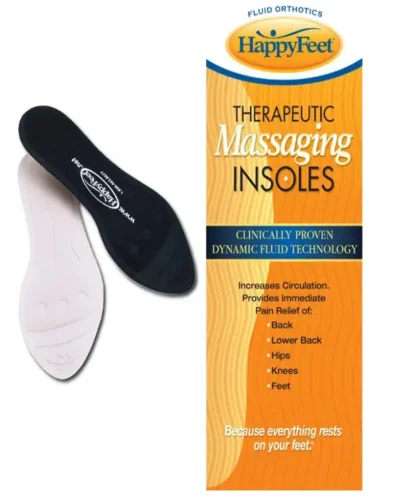
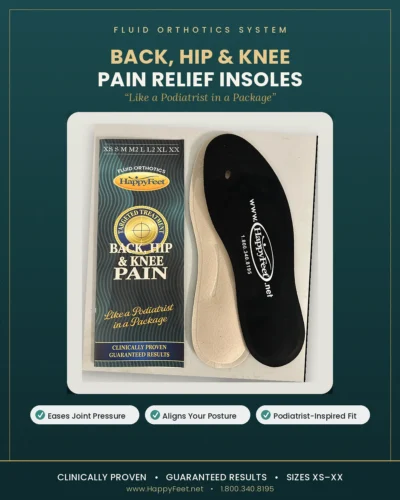
This is exactly the mechanism our Back, Hip and Knee Pain Targeted Treatment insoles are designed around. Rather than cushioning alone, the fluid-filled design is built to gently support the arch through each step, which helps encourage a more neutral foot position and reduces the degree of compensation your knees, hips, and lower back have to make.
In our own clinical study, participants using HappyFeet insoles reported meaningful improvement in this exact area — a 72% average improvement in back pain and a 71% reduction in knee pain among study participants. You can read the full breakdown on our Clinical Study page.
If plantar fasciitis or heel pain is also part of your symptoms, it’s worth looking at our Plantar Fasciitis insoles as well, since heel and arch issues frequently show up alongside knee and back discomfort.
This article is for general educational purposes and isn’t a substitute for professional medical advice. If you’re dealing with persistent or severe back, hip, or knee pain, please consult a doctor or podiatrist to identify the underlying cause.